The Flying Circus Coffee Field Guide

From Grave to Prestissimo

Mapping Caffeine, the Brain, and Musical Tempo

Orientation

Coffee is usually described with vague adjectives: strong, bold, smooth, light. Those words communicate preference, but they lack a shared scale.

Italian tempo markings—Grave, Adagio, Andante, Allegro, Presto—are embodied descriptions of pace. This Field Guide uses that language to describe how coffee feels: not as prescriptive medical advice, but as observations.

Important clarification: BPM in this guide refers to musical tempo (beats per minute), not heart rate.

Educational and observational only. No medical advice. No personalized dosing guidance.

Why Tempo Instead of Milligrams

Milligrams of caffeine measure quantity, not experience. Two people can drink the same coffee and report very different outcomes depending on tolerance, sleep, context, and sensitivity.

Tempo offers a descriptive scale for the felt character of attention and energy—without pretending to offer precision where none exists. In research settings, caffeine is known to influence neural timing and coherence, reaction time and processing latency, motor readiness, and autonomic balance.

  • Neural oscillation timing and coherence
  • Reaction time and processing latency
  • Motor readiness and fatigue resistance
  • Autonomic balance (calm vs. activation)

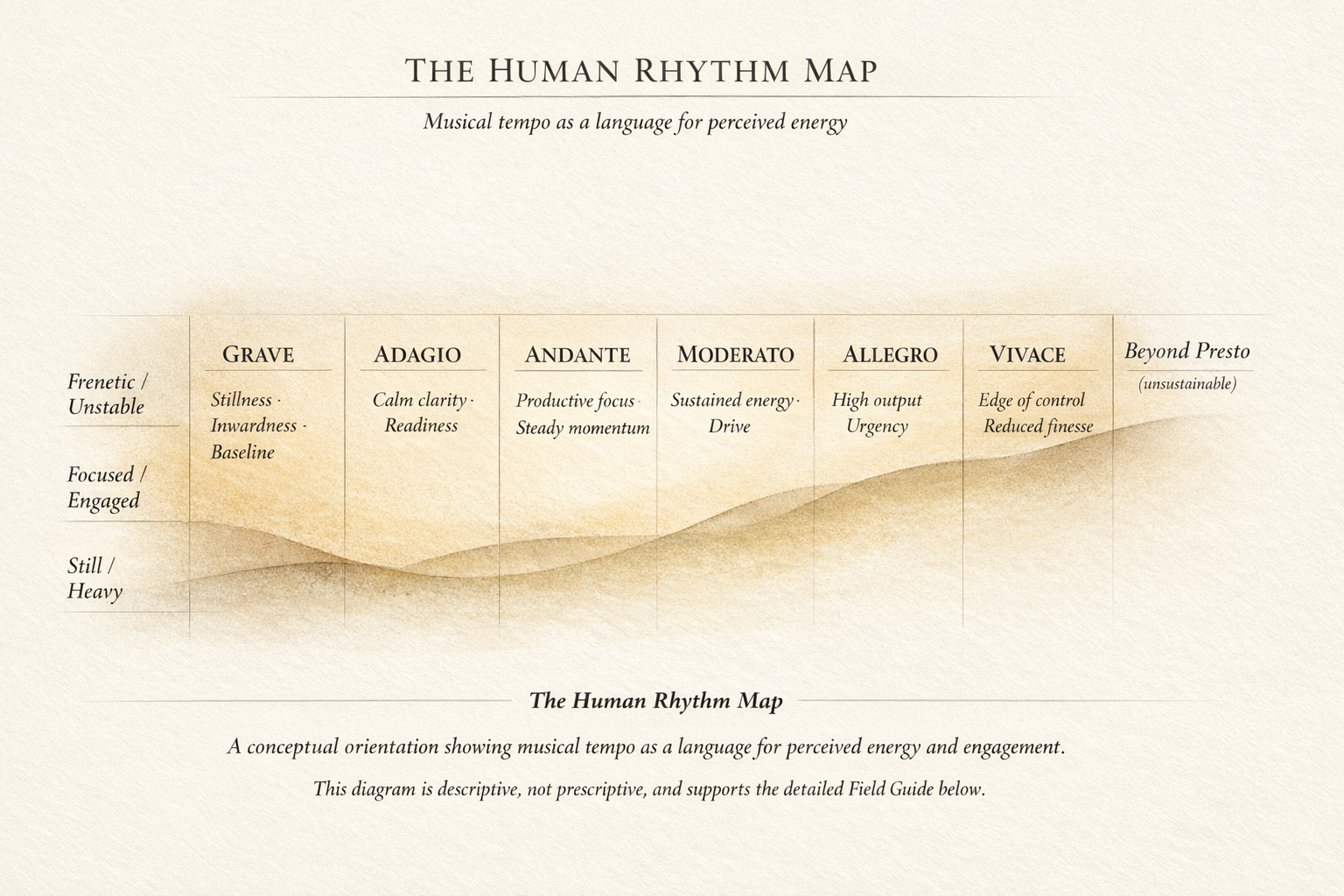
The Human Rhythm Map

The Human Rhythm Map — musical tempo as a language for perceived energy and engagement.

Musical tempo as a descriptive scale for energy and attention. Other physiological markers are shown only as contextual cues, not targets or prescriptions.

The 17-Step Tempo Ladder

Note: One upper-bound category extends beyond traditional Italian tempo markings. It is included deliberately to describe modern, non-musical physiological extremes rather than historical performance practice. Scores are provided for reference and study. All music is in the public domain; engravings are credited and used in accordance with their respective licenses.

Approx. caffeine
~0 mg
Neural tendency
Theta/delta dominant; minimal cortical engagement
Classical reference
Chopin — Funeral March (Piano Sonata No. 2)
Flavor note
Baseline state before stimulation
Rendition: Listen
Score: View

Score source: IMSLP. Engraving and edition credited on the score. Used in accordance with applicable public-domain or Creative Commons licenses.

Approx. caffeine
~15 mg
Neural tendency
Early alpha emergence; drowsiness receding
Classical reference
Handel — “Ombra mai fù” (“Handel’s Largo”)
Flavor note
Very mild coffees; warmth without urgency
Rendition: Listen
Score: View

Score source: IMSLP. Engraving by the credited editor. Used under Creative Commons license for non-commercial educational purposes.

Approx. caffeine
~30 mg
Neural tendency
Alpha stabilizing; attention possible but soft
Classical reference
Mozart — Clarinet Concerto, Adagio (K.622)
Flavor note
Light roasts; gentle acidity; minimal bitterness
Rendition: Listen
Score: View

Score source: IMSLP — public domain edition (clarinet concerto piano reduction).

Approx. caffeine
~45 mg
Neural tendency
Calm alpha rhythm; low beta involvement
Classical reference
Samuel Barber — Adagio for Strings
Flavor note
Smooth, balanced cups; clarity over punch
Rendition: Listen
Score: Score not in the public domain.
Approx. caffeine
~60 mg
Neural tendency
Alpha peak frequency increases slightly
Classical reference
Mahler — Symphony No. 5, Adagietto
Flavor note
Elegant profiles; nuance preserved
Rendition: Listen
Score: Score not in the public domain.
Approx. caffeine
~75 mg
Neural tendency
Alpha dominant with emerging beta
Classical reference
Haydn — Symphony No. 94 (“Surprise”), Andante
Flavor note
Classic medium roasts; balance and approachability
Rendition: Listen
Score: View

Score source: IMSLP — public domain edition (excerpt) Opening theme and first variation, including the famous unexpected fortissimo chord.

Approx. caffeine
~90 mg
Neural tendency
Beta activity increases; alpha recedes during tasks
Classical reference
Mozart — Piano Sonata No. 11, Andante grazioso (K.331)
Flavor note
Brighter profiles tolerated without harshness
Rendition: Listen
Score: View

Score source: IMSLP — public domain edition (excerpt) Opening Theme and First Variation — a poised Andante grazioso in lilting siciliano rhythm, introducing Mozart’s most graceful variation set.

Approx. caffeine
~110 mg
Neural tendency
Task-focused beta predominance
Classical reference
Johann Strauss I — Radetzky March
Flavor note
Bolder cups; structure over delicacy
Rendition: Listen
Score: View

Score source: IMSLP. Engraving by the credited editor. Used under Creative Commons license for non-commercial educational purposes.

Approx. caffeine
~130 mg
Neural tendency
Beta dominant; fast processing
Classical reference
Mozart — Symphony No. 40, Molto allegro
Flavor note
Firm body; reduced acidity; more roast presence
Rendition: Listen
Score: View

Score source: IMSLP — public domain edition (excerpt) Opening Exposition — a relentless Molto allegro driven by syncopation and urgency, defining Mozart’s most restless symphonic voice

Approx. caffeine
~150 mg
Neural tendency
High beta with gamma bursts
Classical reference
Beethoven — Symphony No. 7, Allegretto
Flavor note
Bitterness tolerated; complexity still readable
Rendition: Listen
Score: View

Score source: IMSLP — public domain edition (excerpt) Excerpt: Opening procession and ostinato-driven build (Allegretto)

Approx. caffeine
~180 mg
Neural tendency
Highly synchronized beta
Classical reference
Mozart — Eine kleine Nachtmusik, Allegro
Flavor note
Fuller body; crema-forward profiles
Rendition: Listen
Score: View

Score source: IMSLP — public domain edition Allegro — A masterclass in Classical propulsion, where clarity, symmetry, and elegance generate momentum without haste.

Approx. caffeine
~210 mg
Neural tendency
High beta / low gamma
Classical reference
Rossini — William Tell Overture (Finale)
Flavor note
Bold, assertive; nuance yields to drive
Rendition: Listen
Score: View

Score source: IMSLP — Breitkopf & Härtel full score (public domain).Excerpted for educational reference.

Approx. caffeine
~240 mg
Neural tendency
Strong sympathetic activation
Classical reference
Beethoven — Symphony No. 9, Scherzo
Flavor note
Intensity over subtlety
Rendition: Listen
Score: View

Score source: IMSLP — Breitkopf & Härtel (public domain).Excerpted for educational reference. Movement II (Scherzo): Molto vivace The relentless rhythmic engine and explosive orchestral energy that redefined the symphonic scherzo.

Approx. caffeine
~280 mg
Neural tendency
Beta/gamma crowding
Classical reference
Rimsky-Korsakov — Flight of the Bumblebee
Flavor note
Sharp, forceful; bitterness prominent
Rendition: Listen
Score: View

Score source: Score edited by Alan Chen. Licensed under Creative Commons Attribution 3.0. Source: IMSLP. Orchestral excerpt. Visual reference for extreme perpetual motion, not structural analysis.

Approx. caffeine
~320 mg
Neural tendency
Overactivation likely
Classical reference
Beethoven — Symphony No. 5, Finale
Flavor note
Power-focused blends
Rendition: Listen
Score: View

Score source: IMSLP — Breitkopf & Härtel (public domain).Excerpted for educational reference. The page shows “Presto” at the top — Beethoven marks the Finale Allegro / Presto-driven from the outset. The key has shifted decisively to C major, which is the dramatic structural goal of the entire symphony.

Approx. caffeine
~380 mg
Neural tendency
Coherence drops; jitter risk
Classical reference
Vivaldi — Summer (Presto), The Four Seasons
Flavor note
Intensity eclipses elegance
Rendition: Listen
Score: View

Score source: Vivaldi — The Four Seasons, Summer, III. Presto. Mutopia Project edition (2010). CC BY-SA 3.0. Source: IMSLP.

Approx. caffeine
~450+ mg
Neural tendency
Saturation; diminishing control
Classical reference
Prokofiev — Dance of the Knights
Flavor note
Not about taste — about force
Rendition: Listen
Score: Score not in the public domain.

Flavor & Force: Taming the Beast

As caffeine intensity rises—often via higher Robusta percentages—flavor profiles tend to shift. This is a trade-off, not a flaw.

  • Robusta tends to add: caffeine density, crema, body, structural bitterness
  • Robusta can diminish: aromatic nuance, perceived sweetness, acidity complexity

The goal is not to hide the trade-offs, but to help you choose knowingly. If you enjoy experimenting, you can explore Arabica × Robusta ratios to find your preferred balance of elegance and force.

Balance & Restraint

In music, speed without control becomes noise. The same principle applies here. Higher tempo is not inherently better. Many of the most precise, satisfying human performances occur well below Presto.

Precision often lives well below Presto.